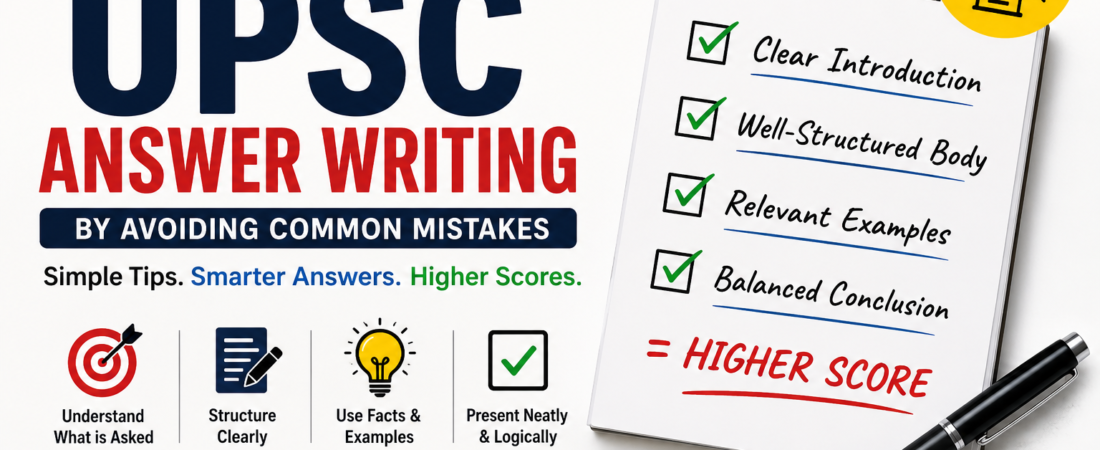
Did you know that nearly 90% of candidates who clear the preliminary stage struggle to translate their knowledge into high-scoring responses during the main examination? This gap often determines who secures a top rank and who misses the cut by a narrow margin.

Mastering the art of structured expression is essential for your success in the civil services. By learning to identify common UPSC answer writing mistakes early, you gain a significant edge over the competition. This proactive approach allows you to refine your style and boost your overall performance effectively.
Our goal is to provide a friendly roadmap to help you avoid mistakes upsc mains answers often contain. Let us explore how you can transform your preparation into a winning strategy today.
Key Takeaways
- Recognize that clear communication is just as vital as factual knowledge.
- Identify recurring errors early to save valuable preparation time.
- Focus on structure and logical flow to improve your final scores.
- Use a consistent practice routine to build confidence before the exam.
- Learn to adapt your style to meet the specific demands of different subjects.
Understanding the UPSC Mains Evaluation Process
Decoding the UPSC Mains evaluation process is essential for avoiding common UPSC answer writing mistakes. Examiners review thousands of scripts, meaning they look for specific markers of quality that stand out immediately. By aligning your writing style with these expectations, you transform your answers from basic responses into high-scoring content.
What Examiners Look For in Your Answers
The evaluation process is not just about factual accuracy; it is about analytical depth. Examiners prioritize candidates who demonstrate a clear understanding of the core issue rather than those who simply list memorized facts. A strong answer connects static knowledge with current events, showing that you can apply concepts to real-world scenarios.
Logical presentation is another pillar of a successful script. When your arguments follow a coherent path, the examiner can easily track your reasoning. Avoiding UPSC answer writing mistakes requires you to structure your thoughts so that each point builds upon the previous one, leading to a well-rounded conclusion.
The Importance of Clarity and Conciseness
Clarity and conciseness are fundamental necessities for effective communication under exam pressure. You have limited time and space, so every word must serve a purpose. Over-explaining simple concepts often leads to losing the examiner’s interest, which is a common trap for many aspirants.
By keeping your language direct, you ensure that your main arguments remain the focus of the page. This approach helps you avoid unnecessary UPSC answer writing mistakes that clutter your response. The following table highlights the key differences between average and high-scoring answer traits.
| Feature | Average Answer | High-Scoring Answer |
|---|---|---|
| Structure | Disorganized paragraphs | Logical, bulleted flow |
| Content | General, vague statements | Data-backed, specific facts |
| Analysis | Surface-level description | Multidimensional perspective |
| Presentation | Dense, long text blocks | Clear headings and diagrams |
Common UPSC Answer Writing Mistakes You Must Avoid
If you want to avoid mistakes in UPSC mains answers, you must first master the art of reading the question carefully. Many aspirants lose valuable marks simply by failing to grasp what the examiner is actually asking for. Understanding the nuances of the prompt is the first step toward a high-scoring response.
Misinterpreting the Directive Words
Directive words act as the compass for your answer. Words like “critically examine,” “discuss,” or “elucidate” are not interchangeable. If a question asks you to “critically examine” a policy, you must provide both the strengths and the limitations, rather than just describing the policy.
Failing to identify these cues is one of the most common mistakes in UPSC answer writing. When you ignore the specific directive, your answer loses its logical flow and fails to address the core requirement of the examiner.
| Directive Word | Primary Expectation | Key Action |
|---|---|---|
| Discuss | Debate and provide details | Present multiple viewpoints |
| Critically Examine | Analyze pros and cons | Provide a balanced judgment |
| Elucidate | Explain clearly | Use examples and facts |
| Comment | Express an opinion | Support with evidence |
Ignoring the Word Limit Constraints
Strict adherence to word limits is essential for time management. Writing too much on a single question often forces you to rush through later questions, which lowers your overall score. You should practice drafting answers that are concise yet comprehensive.
Focus on quality over quantity. A well-structured answer that hits the word limit is far more effective than a long, rambling essay that misses the point. Use bullet points to keep your arguments sharp and easy to read.
Lack of Focus on the Core Question
It is easy to get distracted by peripheral information that you happen to know well. However, including irrelevant facts will not earn you extra marks. Always ensure that every sentence you write directly supports the main argument of the question.
If you find yourself drifting away from the topic, pause and re-read the prompt. Staying focused is the best way to avoid mistakes in UPSC mains answers and ensure your response remains impactful throughout the exam. Keep your content relevant to the specific context provided in the question paper.
Structural Flaws in UPSC Mains Answers
Building a strong answer requires more than just knowledge; it demands a clear and logical structure. Many aspirants focus heavily on facts but often overlook the architectural integrity of their responses. Recognizing these common mistakes in upsc answer writing is the first step toward improving your overall score.
The Failure to Provide a Balanced Introduction
An introduction serves as the gateway to your answer. It should provide necessary context while setting a professional tone for the examiner. Failing to provide a balanced opening often leaves the evaluator searching for the core intent of your response.
A great introduction should be concise and directly address the question asked. Avoid overly generic statements that do not add value to your argument. Instead, try to include a relevant definition, a constitutional reference, or a current event to grab attention immediately.
Weak Body Paragraphs and Lack of Cohesion
The body of your answer is where you demonstrate your analytical depth. One of the most common mistakes in upsc answer writing is creating disjointed paragraphs that lack logical flow. When ideas do not transition smoothly, the examiner may struggle to follow your line of reasoning.
To fix this, ensure that each paragraph focuses on a single, distinct point. Use transition words like “furthermore,” “consequently,” or “in contrast” to link your thoughts together. Cohesion is the glue that holds your arguments together and makes your answer persuasive.
Inadequate Conclusion and Way Forward
Many students treat the conclusion as an afterthought, but it is your final chance to leave a lasting impression. A strong conclusion should summarize your main points while offering a forward-looking perspective. This is often referred to as the “Way Forward” in the context of policy-based questions.
Avoid simply repeating what you have already written in the body. Instead, suggest practical solutions or highlight the long-term impact of the issue discussed. By providing a balanced and optimistic closing, you demonstrate a mature understanding of the subject matter, which is highly valued by UPSC evaluators.
Content Quality and Data Integration Errors
Your ability to curate relevant information is a critical skill that separates top-tier candidates from the rest. While it is tempting to showcase everything you know, the UPSC Mains rewards precision over volume. Understanding these common upsc answer writing pitfalls to avoid will help you refine your approach and improve your overall score.
Overloading Answers with Irrelevant Facts
Many aspirants fall into the trap of dumping every piece of information they have memorized onto the paper. This practice often leads to a loss of focus and obscures the core argument of your response. Always remember that every fact you include must serve a specific purpose in answering the question asked.
If a fact does not directly support your thesis, it is likely just clutter. You should prioritize concise explanations that demonstrate your understanding of the topic. By trimming the excess, you allow your strongest points to shine through clearly.
Failing to Link Static Knowledge with Current Affairs
A high-scoring answer often bridges the gap between foundational concepts and recent developments. When you rely solely on static textbook knowledge, your response may appear outdated or incomplete. Integrating current events shows the examiner that you possess a multidimensional understanding of the subject matter.
Try to weave in recent policy changes, landmark court judgments, or international agreements where applicable. This technique transforms a standard answer into a sophisticated analysis. It is one of the most effective upsc answer writing pitfalls to avoid for those aiming for a top rank.
Neglecting to Use Official Reports and Data
Adding credibility to your arguments is essential for building authority in your writing. Many candidates overlook the power of citing official government reports, such as the Economic Survey or NITI Aayog documents. These sources provide empirical evidence that makes your arguments difficult to challenge.
Using specific data points, such as percentage growth or committee recommendations, adds weight to your claims. When you ground your analysis in verified facts, you demonstrate a professional and objective mindset. This simple habit is a key strategy to ensure your answers stand out during the evaluation process.
Time Management Pitfalls During the Exam
Time management is often the deciding factor between a successful attempt and a missed opportunity in the UPSC Mains. Many aspirants struggle to balance their depth of knowledge with the strict constraints of the examination hall. Recognizing these upsc answer writing pitfalls to avoid is the first step toward ensuring you complete your paper with confidence.
Spending Too Much Time on Known Topics
It is natural to feel excited when you encounter a question you know well. However, spending excessive time on these topics often leads to a diminishing return on your total score. You might write a perfect answer for one question, but you sacrifice the chance to earn marks on others.
Always remember that every mark counts toward your final rank. Instead of writing exhaustive essays on familiar subjects, stick to the core requirements of the question. Efficiency is key to maintaining a consistent performance across all papers.
The Danger of Leaving Questions Unanswered
Leaving a question blank is one of the most significant errors you can make. Even a mediocre answer can fetch you a few marks, whereas a blank space guarantees zero. These upsc answer writing pitfalls to avoid are critical because they directly impact your final standing.
If you find yourself running low on time, prioritize writing a brief structure or a few bullet points for the remaining questions. Partial credit is far better than no credit at all. Keep a close eye on the clock to ensure you distribute your effort evenly.
Strategies for Rapid Planning and Drafting
To manage your time effectively, you must practice rapid planning before you start writing. Spend the first minute of each question identifying the directive word and the core demand. This prevents you from drifting off-topic and helps you draft a focused response quickly.
Using a structured approach allows you to maintain speed without sacrificing quality. The following table provides a recommended time allocation strategy to help you stay on track during the exam.
| Question Type | Recommended Time | Key Focus Area |
|---|---|---|
| 10-Marker | 7 Minutes | Direct, concise points |
| 15-Marker | 11 Minutes | Balanced, analytical depth |
| Planning Phase | 1 Minute | Structure and keywords |
| Final Review | 1 Minute | Highlighting key terms |
By adopting these strategies, you can ensure that your time management remains a strength rather than a liability. Consistent practice will help you internalize these habits, allowing you to perform at your best under pressure.
Addressing Examiner Feedback and Common Criticisms
Turning feedback into a roadmap for improvement is a skill every successful candidate masters. While receiving critiques can feel daunting, it serves as the most effective tool for refining your writing style. By viewing these notes as valuable guidance rather than personal failure, you can accelerate your preparation significantly.

Interpreting Constructive Criticism from Mentors
Mentors often highlight specific areas where your logic or structure falls short. Instead of feeling discouraged, break down their comments into actionable tasks. If a mentor suggests your introduction is weak, focus your next practice session solely on drafting compelling hooks.
Always maintain a dedicated notebook to track recurring suggestions. This helps you identify patterns in your writing that might otherwise go unnoticed. When you address these points systematically, you eliminate typical upsc answer errors before they become permanent habits.
Common Pitfalls Identified by Toppers
Successful candidates often share similar stories about their early struggles with answer writing. They frequently note that ignoring the core demand of the question is a major hurdle. Toppers emphasize that clarity and precision are far more important than filling pages with excessive information.
Many aspirants also fall into the trap of neglecting the conclusion or failing to provide a balanced perspective. By studying these common mistakes, you can proactively adjust your strategy. The following table outlines how to transform these common errors into high-scoring habits.
| Common Error | Topper’s Perspective | Corrective Action |
|---|---|---|
| Ignoring Directive Words | Misinterpreting the prompt | Analyze keywords like ‘Discuss’ or ‘Critically Examine’ |
| Lack of Structure | Disorganized flow | Use clear headings and bullet points |
| Ignoring Data | Generic arguments | Integrate official reports and statistics |
| Typical UPSC Answer Errors | Repeating mistakes | Maintain a feedback log for revision |
How to Fix UPSC Answer Writing Errors Effectively
You can transform your performance by adopting a rigorous process to catch and correct typical upsc answer errors. Simply writing more is not enough to guarantee success in the civil services examination. Instead, you must cultivate a mindset that values quality analysis over sheer volume.
Developing a Systematic Revision Strategy
A strong revision strategy starts with maintaining a dedicated error log. Every time you finish a practice test, review your feedback and categorize your mistakes into themes like content, structure, or time management.
By tracking these patterns, you can identify which areas require immediate attention. Consistency is key when you are trying to break bad habits that have developed over months of preparation.
- Review your previous three answers before starting a new one.
- Focus on one specific improvement area per week, such as better introduction writing.
- Keep a checklist of common pitfalls to consult before you submit any draft.
Self-Evaluation Techniques for Better Performance
To improve, you must learn to critique your own work with the eyes of an examiner. Set your answer aside for at least twenty-four hours before you attempt to grade it yourself. This distance helps you view your writing with greater objectivity.
Ask yourself if the introduction directly addresses the core question. Check if your arguments are supported by relevant data or constitutional provisions. If you find yourself struggling to follow your own logic, it is a clear sign that your structure needs refinement.
Utilizing Model Answers for Benchmarking
Model answers serve as a vital tool for understanding the standard of excellence required for high-scoring responses. When you compare your work to a topper’s script, look for differences in depth and presentation.
Do not just copy the content; instead, analyze the logical flow and the way they integrate current affairs. Using these benchmarks helps you recognize typical upsc answer errors that you might otherwise overlook in your own drafts. This practice bridges the gap between your current performance and the level expected by the UPSC commission.
Mastering the Art of Answer Structuring
Mastering the visual flow of your writing is a key step in how to fix UPSC answer writing errors. While the depth of your knowledge is paramount, the way you present that information determines how quickly an examiner can grasp your arguments. A cluttered page often leads to missed points, whereas a well-structured response invites a higher score.
Using Bullet Points vs. Paragraphs
Deciding between bullet points and paragraphs is a strategic choice that depends on the nature of the question. Paragraphs are best suited for analytical or descriptive parts of your answer where you need to build a narrative or explain complex theories. They allow you to demonstrate depth and critical thinking.
Conversely, bullet points are your best friend when listing features, advantages, or data-heavy points. They break up dense text and make your answer highly readable. Use them to highlight:
- Key arguments or distinct points.
- Statistical data or committee recommendations.
- Steps in a process or chronological events.
Creating Logical Flow Between Sections
A strong answer must feel like a cohesive story rather than a collection of random facts. You can achieve this by using effective transition words that link your introduction, body, and conclusion. Phrases like “Furthermore,” “In contrast,” or “Consequently” help the examiner follow your train of thought without confusion.
Ensure that each paragraph or bulleted section directly addresses a specific part of the question. If you jump between unrelated topics, you lose the examiner’s interest. Logical sequencing is essential to maintain the momentum of your argument from start to finish.
Highlighting Keywords for Better Readability
Examiners often scan answers quickly, so you must make your most important points stand out. Underlining or boxing specific keywords, such as Constitutional articles, landmark judgments, or core terminology, ensures they are noticed immediately. This simple technique acts as a roadmap for the person grading your paper.
Be careful not to overdo it, as too much underlining can make the page look messy. Focus on highlighting only the most impactful terms that define your answer. By refining these structural habits, you will learn exactly how to fix UPSC answer writing errors and present your knowledge with confidence.
Enhancing Presentation with Diagrams and Flowcharts
If you want to know how to fix upsc answer writing errors, start by mastering the art of visual presentation. Examiners often review hundreds of papers daily, making clear and concise layouts a major advantage. By integrating simple sketches, you can break the monotony of long paragraphs and highlight key arguments effectively.

When and Where to Use Visual Aids
Visual aids work best when they simplify complex data or show relationships between different concepts. Use a flowchart to explain a process, such as the legislative cycle or the stages of a policy implementation. Maps are essential for geography, disaster management, or international relations questions where location plays a critical role.
Avoid overusing these tools, as they should support your text rather than replace it. Place your diagrams near the relevant paragraph to ensure the examiner can easily connect the visual to your written analysis. This strategic placement is a proven method for those learning how to fix upsc answer writing errors.
Simple Techniques for Drawing Maps and Diagrams
You do not need to be an artist to create professional-looking visuals. Focus on geometric shapes like circles, squares, and arrows to build your flowcharts quickly. Keep your maps schematic by drawing basic outlines of states or regions without worrying about perfect accuracy.
Practice drawing these elements during your daily study sessions to build muscle memory. Using a pen for both text and diagrams maintains a consistent look throughout your answer sheet. Speed is vital, so keep your sketches small and clean to save time for other sections.
Balancing Text and Visuals for Impact
The secret to a high-scoring answer lies in the balance between descriptive text and visual representation. Your diagrams should act as a summary or a supplement to your main points. Always provide a brief introductory sentence before your visual aid to guide the examiner through the information.
Ensure that your labels are legible and directly related to the question asked. By refining this balance, you will find it much easier to know how to fix upsc answer writing errors and improve your overall presentation. A clean, organized page is always more inviting to read and easier to grade.
The Role of Practice and Peer Review
Transforming your writing style into a high-scoring asset is best achieved through the power of daily practice and peer review. Many aspirants focus heavily on gathering information but often neglect the mechanical process of putting thoughts onto paper. Consistent answer writing is the only way to build the necessary muscle memory for the high-pressure environment of the UPSC exam.
The Benefits of Daily Answer Writing Practice
When you write every day, you begin to internalize the structure of a perfect response naturally. This habit helps you manage your time better and ensures that you do not panic when facing a difficult question. By practicing regularly, you learn how to present your arguments in a way that is clear and appealing to the examiner.
“Feedback is the breakfast of champions, and in the journey of civil services, it is the compass that keeps you on the right path.”
Daily practice allows you to experiment with different formats, such as using flowcharts or bullet points, without the fear of failure. You will find that your ability to synthesize complex information improves significantly over time. This feedback loop, even when self-administered, is vital for long-term growth.
How to Conduct Effective Peer Reviews
Collaborative learning through peer review is a powerful tool for identifying blind spots that you might otherwise miss on your own. When you exchange answers with a fellow aspirant, you gain a fresh perspective on your work. This process helps you understand how an examiner might interpret your logic and clarity.
To conduct an effective review, you should focus on specific criteria rather than just general praise. Use the following table to guide your collaborative sessions and ensure that both parties benefit from the exchange.
| Review Criteria | Self-Evaluation | Peer Review |
|---|---|---|
| Structure | Subjective | Objective |
| Content Depth | Limited | Comprehensive |
| Time Management | Often Ignored | Strictly Monitored |
| Clarity | Biased | Neutral |
Always maintain a professional and constructive tone during these sessions. Remember that the goal is to improve your UPSC performance collectively. By sharing feedback openly, you create a supportive environment that fosters excellence and reduces the anxiety associated with the final exam.
Advanced Tips for High-Scoring Answers
Achieving a top rank in the UPSC examination requires moving beyond basic facts to demonstrate deep analytical maturity. Many aspirants struggle with upsc answer structure mistakes, but adding depth through diverse lenses can be a game-changer for your final score. By shifting your focus from mere information retrieval to critical analysis, you can effectively distinguish your paper from the crowd.
Adding Multidimensional Perspectives
To provide a comprehensive analysis, you must view every problem through various prisms. Instead of providing a one-dimensional response, try to incorporate social, economic, and political dimensions into your arguments. This approach demonstrates that you understand the interconnected nature of governance and public policy.
For instance, when discussing a policy, consider its impact on marginalized communities, its fiscal feasibility, and its alignment with current political trends. This multidimensional approach prevents common upsc answer structure mistakes by ensuring your response remains balanced and thorough. Evaluators appreciate candidates who can synthesize these different viewpoints into a cohesive narrative.
Incorporating Ethical and Constitutional Angles
Integrating ethical and constitutional frameworks adds significant weight to your answers. You should aim to link your arguments to specific Constitutional Articles or Directive Principles of State Policy whenever possible. This shows the examiner that your reasoning is grounded in the foundational values of the Indian state.
Furthermore, applying an ethical lens helps you address complex dilemmas with nuance. By discussing concepts like constitutional morality, transparency, and accountability, you elevate the quality of your content. Avoiding upsc answer structure mistakes means ensuring these high-level concepts are woven naturally into your body paragraphs rather than forced at the end.
| Feature | Basic Answer Approach | Advanced Answer Approach |
|---|---|---|
| Perspective | Single-dimensional | Multidimensional |
| Evidence | General statements | Constitutional/Legal backing |
| Analysis | Descriptive | Critical and Evaluative |
| Impact | Average score | High-scoring potential |
Conclusion
Achieving excellence in the UPSC Mains requires a shift in perspective regarding your daily study habits. You should view every practice session as a vital step toward refining your unique voice and analytical depth.
Reflecting on your progress helps you identify specific upsc answer writing tips that work best for your personal style. You gain confidence by actively addressing your upsc answer writing mistakes during mock tests and peer reviews.
Consistency remains the most powerful tool in your preparation toolkit. Small adjustments to your structure and data integration lead to significant improvements in your overall score over time.
Keep your focus sharp and your mindset resilient as you navigate this challenging journey. Every effort you invest today brings you closer to your goal of serving the nation as a civil servant. Start your next practice session with renewed energy and purpose.
FAQ
What are the most common mistakes in upsc answer writing that I should look out for?
One of the most frequent errors is failing to address the actual question asked. Many candidates fall into the trap of writing everything they know about a topic rather than focusing on the specific prompt. Other typical upsc answer errors include poor time management, where students spend too long on familiar topics and leave other questions completely blank.
How can I identify the upsc answer writing pitfalls to avoid during my preparation?
The best way to identify these pitfalls is through consistent practice and seeking examiner answer writing feedback upsc. Pay close attention to how you interpret directive words like “Critically Analyze” or “Evaluate.” Misunderstanding these directives is a major upsc answer writing tips mistake that can lead to a response that doesn’t meet the commission’s expectations.
What are the typical upsc answer structure mistakes that hurt my overall score?
Many aspirants struggle with “structural drift,” where the answer lacks a clear introduction, a cohesive body, and a forward-looking conclusion. To avoid mistakes upsc mains answers often have, ensure your introduction sets a clear context and your body paragraphs use logical transitions. A weak or missing “Way Forward” in the conclusion is another structural flaw that evaluators frequently point out.
Can you explain how to fix upsc answer writing errors related to content quality?
Improving content quality involves moving away from “fact-dumping” and toward analytical depth. You can learn how to fix upsc answer writing errors by effectively integrating current affairs with static syllabus topics. Using official data from sources like the NITI Aayog reports or the Economic Survey adds instant credibility and authority to your arguments.
Is it better to use bullet points or paragraphs to avoid common upsc answer writing tips mistakes?
There is no one-size-fits-all answer, but a mix is usually best. Use bullet points to list features, reasons, or points of impact to improve readability, and use paragraphs for complex analysis. Highlighting keywords is another great way to ensure the examiner sees your main points quickly, which helps overcome the issue of cluttered presentation.
How should I use examiner answer writing feedback upsc to improve my performance?
Treat feedback from mentors or platforms like Vision IAS as a diagnostic tool. Don’t just read the comments; categorize them into “content gaps,” “structure issues,” or “time management.” By benchmarking your work against model answers provided by toppers like Shruti Sharma or Kanishak Kataria, you can see exactly where your presentation falls short of the gold standard.
Why is it important to include diagrams and flowcharts in my answers?
Visual aids like flowcharts and maps are excellent for simplifying complex information and saving time. They allow you to present multidimensional data at a glance, which is a great way to avoid mistakes upsc mains answers make when they become too wordy or repetitive. Just be sure the diagram is relevant and properly labeled to add real value to your response.
What is the benefit of daily answer writing practice and peer review?
Daily practice builds the “muscle memory” needed to draft high-quality answers under intense exam pressure. Engaging in peer review with fellow aspirants helps you spot blind spots and typical upsc answer errors that you might miss during self-evaluation. It turns the preparation process into a collaborative journey of continuous improvement.